

1976
Fifty years on, we still live in the shadow of America's bicentennial

Playtime is a newsletter that takes many shapes including personal essay, critical analysis, recommendation, and interview. It’s a space to celebrate doing for the fun of doing, connection, and culture. We play music, We play sports, We play pretend. It’s Playtime. Thanks for reading. If you enjoy, subscribe and be sure to check your spam or promotions folder.
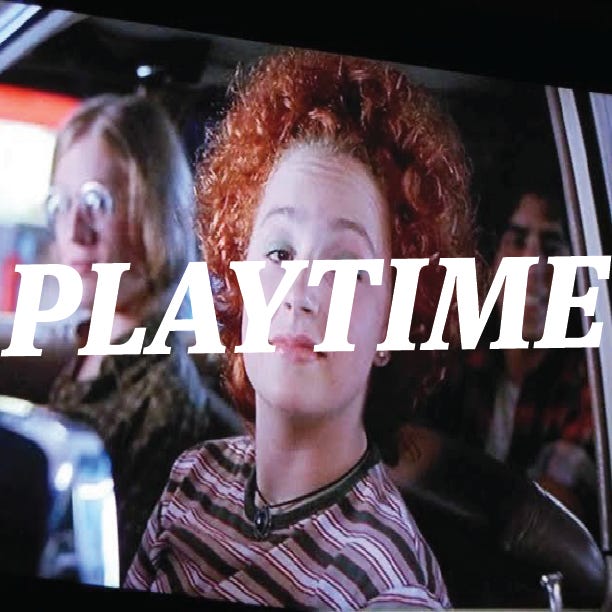
Dazed and Confused is likely responsible for my fascination with the cyclical nature of history. A key scene in the film introduced me to the “every other decade” theory. In summation; some eras rock, others suck.
The film takes place in 1976, on the last day of school before the American Bicentennial summer. From his vantage point—my birth year of 1993—writer/director Richard Linklater renders the period with warmth and longing, creating a nostalgic portrait of a simpler America, an era now distant enough to feel almost impossibly quaint. There’s an element of cheekiness to the every other decade theory being discussed by characters in a movie about how the seventies were awesome, who are convinced the seventies are a low point for culture, and who can’t wait to see what the eighties have in store.
To be fair to Cynthia Dunne—played by Marissa Ribisi—the post-Watergate hangover was real. Distrust, inflation, gas shortages, urban decay, and the lingering psychic exhaustion of the Vietnam era had begun to erode the idealism that defined the previous decade.
It’s often taken for granted how foundational the culture of the mid-seventies became to everything that followed. The reaction against sixties utopianism, maximalism, and hippie idealism permanently reshaped the cultural landscape. Most visibly through punk, but also through the earliest formations of hip-hop, dub, and the fractured auteur visions of New Hollywood cinema, artists began replacing polished optimism with something more observational, raw, and psychologically unsettled.
The pendulum swung from bubblegum escapism toward detached realism, from faith in institutions toward reliance on the individual, from virtuosity toward immediacy and expression. Fifty years later, the emotional atmosphere of those works feels less like history and more like a previous version of the present.
So what does that swing feel like on a personal level? It could be the apotheosis of paranoia in Taxi Driver, the listless wandering of Joni Mitchell’s Hejira, or Bowie’s isolationist masterpiece Station to Station. What do they have in common? Not only are they documents of reinvention but all three are observations of restless motion and spiritual search without framework.
Travis Bickle spends most of Taxi Driver in motion, almost participating with the decaying empire around him, but in reality only observing in a state of detachment. His job brings him into contact with society around him, but his station in life leaves him unable to render any meaningful connection. In many ways, Bickle becomes an avatar for the atmosphere of 1976 itself. Overstimulated, distrustful, hyper-observant, and increasingly untethered from collective meaning despite a physical and emotional search for greater connection and community.
Hejira presents a more expansive and spiritual sort of wandering. Written after the culmination of three road trips across America, a cocktail of emotional upheaval, cocaine addiction and rehabilitation via Tibetan Buddhism, combined with mounting exhaustion and growing need for distance and self-isolation, came together in a stunning work encapsulating the post-hippie fallout and resurrection in New Age individual spiritualism. Its title references the Arabic word for journey or migration. The record feels suspended in the highways, hotel rooms, deserts, coastlines, and interior monologues that blend together to create a singular emotional landscape.
An artistic high point in Mitchell’s catalog, Hejira combines her poetic, deeply introspective writing with sparse arrangements anchored by her acoustic guitar and the prodigious fretless bass playing of Jaco Pastorius. The sonic quality is often described as “windswept,” a palette that perfectly mirrors the album’s emotional terrain. The songs drift between unresolved relationships, solitude, freedom, and spiritual searching, creating music that feels simultaneously intimate and cinematic.
The communal optimism associated with the folk movement had begun to give way to something more individual, ambiguous, and emotionally hard-won. The spirituality remained, but stripped of certainty. What took its place was observation, motion, and the uneasy realization that freedom and loneliness are often inseparable.
In contrast to Hejira’s earthy travelogues, Bowie’s Station to Station gives tangible form to the untethered nature of psychological dissolution. Historically, Bowie survived through reinvention, and the Thin White Duke persona introduced here feels perhaps most analogous to the modern pop star; aristocratic, detached, hyper-stylized, and emotionally elusive. Across the album, Bowie transforms the down-and-dirty rhythms of American funk into something icy and alien, simultaneously romantic and mechanical.
Bowie later claimed to remember almost nothing about the recording process. Those around him, however — including a young Cameron Crowe, whose memoir The Uncool offers a fascinating portrait of the period — describe an artist deep in their addiction, immersed in occultism and Nietzsche, subsisting largely on milk, peppers, and cocaine while living nocturnally in Los Angeles.
Today, Bowie is remembered as an untouchable cultural icon, but Station to Station serves as a reminder that he once existed closer to the fringes of society than its center. More than simply adopting new personas, Bowie often seemed to use each reinvention as a prism through which emerging subcultures could be refracted back into the mainstream. The instability of identity itself became part of the art.
Like Travis Bickle drifting through New York or Joni Mitchell crossing the country in search of clarity, Bowie’s wandering feels symptomatic of a larger cultural condition. The stable narratives of the previous decade had begun to erode, replaced by movement, performance, fragmentation, and the uneasy sense that modern life held no clear paths to understanding.
This disquieting feeling wasn’t limited to selfhood and personal meaning, but to the systems that had propped society up to this point. The institutions of government, business, and entertainment all were called into question in the wake of the Watergate scandal. The undercurrent of anxiety that drives All the President’s Men is justified when our understanding of what constitutes conspiracy becomes reality. The concrete structure of the “most powerful government in the world” was revealed to be a fallacy, who’s to blame the American people for feeling uncertain and scared?
If journalists emerge as unlikely heroes in All the President’s Men, then Sidney Lumet’s Network immediately complicates any optimism that revelation alone could save the culture. The film presents television not as a vehicle for truth, but as a machine capable of transforming outrage, fear, and psychological collapse into entertainment.
The modern state of political media still struggles to escape the gravitational pull of “I’m mad as hell, and I’m not going to take this anymore!” What was once satire now feels disturbingly prophetic. Network understood earlier than most that media would not merely report public anger, but monetize, amplify, and eventually depend upon it.
So we were mad, avoidant of the powers that be, skeptical of institutions, and in need of something new. Enter CBGB’s. All that matters is raw and therefore real. Sure, “More Than A Feeling” is inescapable on classic rock radio to this day, but the lasting musical legacy of 1976 lies with four kids from Forest Hills, Queens, the Ramones. A return to the cool of 1950’s biker gangs and girl groups—remember our cyclical theory?—albeit amped up to amphetamine pace and stripped of pretense, the self-titled album Ramones provided simplicity as a salve. Their contemporaries Blondie, Patti Smith, Talking Heads, and Television would all follow in their stead with varying degrees of flirtation with pop sheen, but at their core all of these acts remained in touch with the rebellious nature of their infancy in the decaying Lower East Side.
The abrasive and confrontational nature of punk has always been coupled with the DIY mentality, but this was not isolated to 315 Bowery and bands with guitars. Minimalism as aesthetic was being borne of necessity in parks and rec centers all over the city in the form of DJ battles. In 1976 the seeds of hip-hop were being sown. Though the origin is hotly contested, many point to Kool Herc’s influence, transmuting the idea of the Jamaican Sound Clashes1 into mixing exhibitions of funk and breakbeat in the Bronx. Early DJs were using systems to give free parties to the masses, foregoing any traditional venues in favor of bringing the power and the party to the people. While these scenes were bubbling in the underground and indicative of the emotional tenor of the time, they didn’t find mass appeal until a year or two later.
Despite the tendency toward radicalism and paranoia two of the biggest pieces of culture in 1976 are humanist masterpieces. They provide commentary on perseverance and joy in the face of suffering. Rocky and Songs in the Key of Life reject cynicism without denying hardship. Both insist in radically different ways that dignity and collective humanity remain possible even after institutional faith has eroded.
Rocky not only thematically gave us triumph of the common man through hard work and dedication on screen, but Stallone’s insistence to bet on himself as the star and not sell the script without himself attached to the starring role became a societal argument for betting on oneself rather than surrendering ambition to corporate gatekeepers.
Stevie Wonder’s Songs in the Key of Life paints vivid images of poverty, heartbreak, spiritual exhaustion, and inequality, but rather than approach issues from a perspective of narrative detachment, he insists on the possibility of collective humanity. “Village Ghetto Land” is the most literal representation of the issue of inequality, while “Pastime Paradise” is a call to stop wasting time on regurgitating the past or holding out for the future when the first step is to take action, and now. From the opening chorus of “Love’s in Need of Love Today” however, Stevie’s thesis is clear; community, caring, and love offer a way through the tumult, poverty, disparity and uncertain nature of the time. Where the majority of the works touched on here take a—validly—negative bent on the state of the world, Songs in the Key of Life uses its expansive runtime to dissect the entire spectrum of life’s experience.
Fifty years on the world that produced these documents is still uncannily familiar. Technologies have changed but the emotional conditions are strangely intact. We exist in a constant state of institutional distrust, saddled with economic and political insecurity, spiritual searching, not to mention continuous civil and social unrest.
We long for meaning and identity, and just like fifty years ago the time is ripe for a reset. The resonant cultural exports of 1976—punk clubs, block parties, wandering songwriters, paranoid antiheroes, underdog boxers, and ecstatic humanists—attempted to answer the same questions, when the world appears to be crumbling around you, what does it mean to be meaningfully human?
They offered a path forward in localized communities, a return to homespun minimalism, and a rejection of institutions in favor of faith in the individual. While it doesn’t fit neatly into the every other decade theory, fifty years in the past provides inspiration in the path to a better future.
Happy Birthday America
More 1976:
peace and love
-Goldie
speaker system battles in public areas, where the loudest system wins are foundational to Jamaican music, which happened to be entering a golden era of Dub, an ecosystem and genre for another post.